Azeria Studios · TurinTransportation designCase studies 2026

Transportation Design

We design vehicles from the question before the sketch: from early strategy to developed design definition, for manufacturers, start-ups and technology companies. The four case studies below each start with why the vehicle should exist, and end with a design a client can judge, present and build on.

Studio
Independent, founder-led, Turin
Work
Two client programmes, one concept vehicle, one self-initiated study
Disciplines
Exterior · Interior · Package · HMI · CMF · Identity · Visualisation

Selected work

Azeria Studios is an independent design and research studio in Turin, founded by two transportation designers who trained at IAAD. We work directly with manufacturers, start-ups, suppliers and technology companies. The people you meet are the people who draw the work.

Before the sketch

Every programme starts with six questions.

A vehicle is an answer. We settle what it answers before deciding what it looks like, then carry that reasoning into proportion, surface, interior and identity.

  1. Q.01

    Who is the vehicle for?

  2. Q.02

    What is changing in the market?

  3. Q.03

    What technology is enabling it?

  4. Q.04

    What architecture does it require?

  5. Q.05

    What should it emotionally represent?

  6. Q.06

    Why should this vehicle exist?

Capabilities

From the first question to the final form.

  1. 01

    Design strategy

    Deciding what the vehicle should be before deciding what it looks like.

    • Vehicle positioning
    • Product vision
    • Competitor analysis
    • Market positioning
    • User and lifestyle research
    • Design DNA definition
    • Vehicle character definition
    • Portfolio and family strategy
    • Future mobility studies
    • Concept narratives
    • Design direction
  2. 02

    Advanced concept design

    Vehicles that test an idea, a category or a future.

    • Future vehicle concepts
    • Experimental mobility concepts
    • Halo vehicle concepts
    • Alternative vehicle typologies
    • Low-volume vehicle concepts
    • Next-generation vehicle experiences
    • Speculative transportation design
    • Mobility scenario development
  3. 03

    Exterior design

    Proportion first, then surface, then detail.

    • Ideation
    • Sketch development
    • Proportion exploration
    • Stance development
    • Surface language
    • Graphic architecture
    • Lighting concepts
    • Aerodynamic visual integration
    • Wheel design
    • Exterior detailing
    • Final design direction
  1. 04

    Interior design

    Designing the environment, not only the dashboard.

    • Interior architecture
    • Cockpit concepts
    • Seating environments
    • Dashboard architecture
    • Centre-console design
    • Door architecture
    • Control interfaces
    • Storage concepts
    • Material integration
    • Passenger experience
    • Emotional and tactile interaction
  2. 05

    Vehicle packaging + architecture studies

    How emerging vehicle architectures can influence design, proportion and user experience.

    • Dimensional package studies
    • Seating layout exploration
    • Hard-point-informed concept development
    • EV architecture studies
    • Alternative propulsion packaging concepts
    • In-wheel motor architecture exploration
    • Skateboard platform studies
    • Modular platform exploration
    • Wheelbase, track and overhang studies
    • Storage and cargo architecture
    • Component-location studies
  3. 06

    UX / HMI concept design

    Deciding what the driver touches, sees and never has to think about.

    • Driver interaction concepts
    • Instrument architecture
    • Information hierarchy
    • Minimal-screen experiences
    • Physical control strategy
    • Digital interface concepts
    • Analogue and digital interaction
    • Next-generation cockpit concepts
  4. 07

    CMF — colour, material, finish

    The part of a vehicle people remember with their hands.

    • Material direction
    • Trim concepts
    • Colour strategy
    • Sustainable material exploration
    • Metal, leather, textile and composite relationships
    • Surface finishes
    • Tactile design
    • Material storytelling
  5. 08

    3D development

    Concept geometry developed to the point where design decisions can be judged.

    • Concept 3D modelling
    • Form development
    • Digital model refinement
    • Visualisation-ready geometry
    • Blender-based development
    • Design-development surfaces
    • Packaging visualisation
  6. 09

    Visualisation

    Images that let a vehicle be judged, and believed, before it exists.

    • Photorealistic visualisation
    • Concept renders
    • Animation
    • Launch imagery
    • Design presentations
    • Investor visuals
    • Internal design reviews
    • Cinematic vehicle imagery
  7. 10

    Physical development

    Supporting projects as they move from screen to object.

    • Scale models
    • Appearance models
    • Prototype development
    • Show vehicles
    • Demonstrators
    • Low-volume development

Scope by programme

What each programme covered.

Ten disciplines, one structure. Select a programme and the light runs through the disciplines it covered. Azeria leads the creative, strategic and design direction; specialist engineering and production expertise joins as each programme needs it.

All four programmes, drawn as one structure. The light runs from the reason for the vehicle to the images it is presented in.

  1. 01Concept and positioning
  2. 02Sketch development
  3. 03Package and layout
  4. 04Exterior design
  5. 05Interior design
  6. 06Design language
  7. 07UX and HMI
  8. 08Colour, material, finish
  9. 09Brand identity
  10. 10Visualisation and film
Everything connected.Drag to turn
Read as a table
Disciplines covered in each case study
Discipline01Evangelum02Onkochishin03Geepy04Brionvega
Concept and positioning
Sketch development
Package and layout
Exterior design
Interior design
Design language
UX and HMI
Colour, material, finish
Brand identity
Visualisation and film

Programme structure

Built around the project.

Azeria leads the creative, strategic and design direction of each programme. Specialist engineering, technology and production expertise is integrated according to the needs of the project — so every programme is built around the right team, with one coherent direction.

One direction. The right expertise around it.

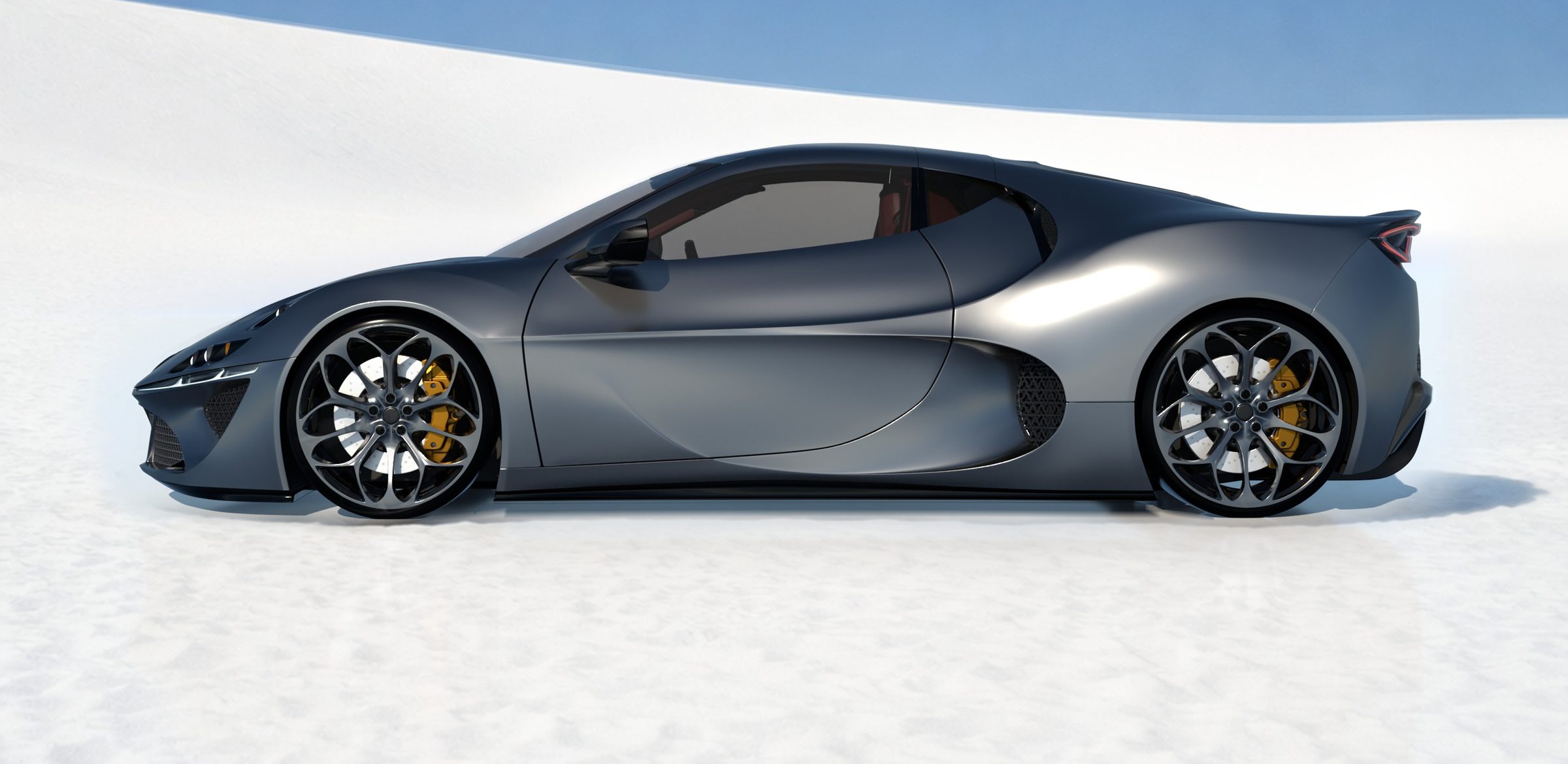
Evangelum in full side profile on white sand under a deep blue sky.
Case study 01Client work

Evangelum

A hypercar and a brand identity for DEUS Automobiles, designed together.

Client
DEUS Automobiles
Programme
Evangelum, two-door hypercar
Status
Design direction and identity. Not a production vehicle.
Scope
Design direction, exterior design and brand identity, developed in parallel
Delivered
Sketch development, 3D design model, photoreal renders, studio film, emblem and wordmark system
Sheet
Case 01 · Evangelum × DEUS Automobiles

The brief

DEUS Automobiles is a young manufacturer entering a crowded field of new hypercars. It needed a car and a brand that could stand next to established names without borrowing from them.

The problem

Making a hypercar look spectacular is relatively easy. Making it recognisable is much harder. Most new entrants end up with a car that could carry anyone's badge.

Our answer

Design the car and the identity in parallel, from one source. We chose Gothic architecture: a structural system that makes heavy buildings feel light through proportion, openings and vertical rhythm, and that gives every line a reason.

The first question

If the logo were removed, would people still recognise it as a DEUS?

Design language

Every line has a reason.

Two principles set the form before any surface was modelled. Both now run through Azeria's design language.

Principle 01

Monumental, yet light.

Strong sculptural volumes alternate with large negative spaces, so the car holds tension without turning into one compact mass. The same way a cathedral carries its weight through its openings.

Principle 02

Chiaroscuro as a design tool.

Each surface is drawn together with the shadow beside it. Masses and voids are designed as pairs to build depth and proportion. Evangelum is the first complete body built on this idea.

E.01Gothic influences: pointed arch, flying buttress and negative space, traced onto the rear of the car.
E.02Design studies: identity, proportion and surface on one sheet.

Sketch to surface

From the first lines to the final form.

Four stages of the same front three-quarter view. Drag across the image, or select a stage, to scan from the first lines to the rendered surface.

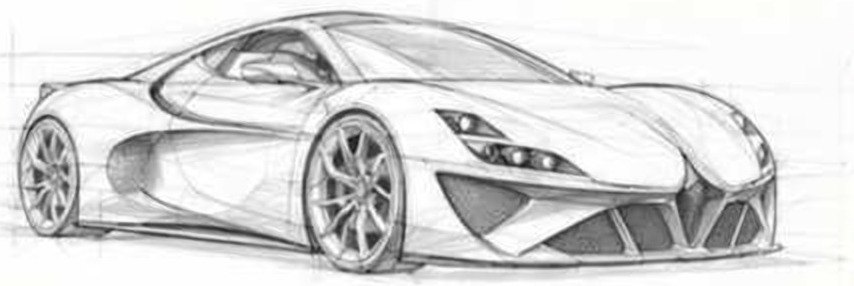
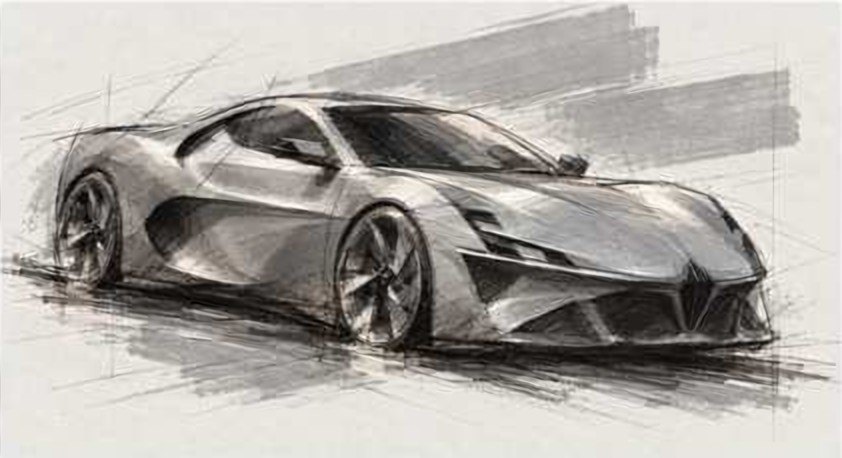
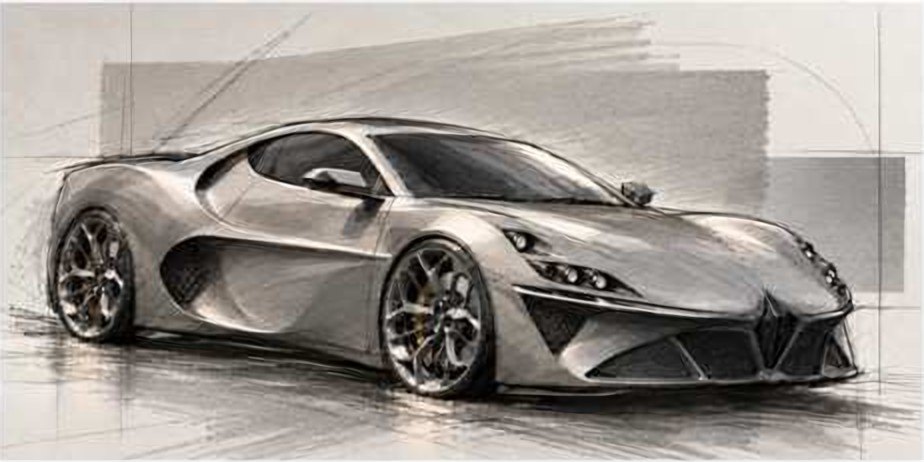
First lines: Proportion and stance in a few strokes: low, wide, cab set well back.Sketch: Volume and light. The flank is carved into one continuous sweep.Rendered sketch: Graphics resolved: stacked lamps, blade light line, diamond nose.Final form: The developed 3D surface, rendered for review.Stage 01 · First lines
S.1Front three-quarter. Low, wide, purposeful: one continuous flow.
S.2Rear. Technical resolution meets pure form.
S.3Side profile. Sculptural surfaces with functional intent.
S.4Top view. Narrow glasshouse, wide front wings.

Signature elements

Recognisable without the badge.

The identity is built into the architecture of the car. These ten elements make it read as a DEUS from any distance. Point at a number to find it.

Evangelum head-on on white sand, with five numbered signature elements on the front.12345
  1. 01Diamond nose element

    A central diamond anchors the front like a keystone, flanked by the two intakes.

  2. 02Stacked round lamps

    Three round units per side with an amber marker, set into the wing.

  3. 03Blade light line

    One thin line runs beneath each lamp cluster and draws the width of the car.

  4. 04Lattice-mesh intakes

    Gothic tracery reworked as a functional mesh, framed by pointed openings.

  5. 05Twin bonnet volumes

    Two sculpted masses either side of a deep central valley.

Evangelum from behind and above, with five numbered signature elements on the rear.678910
  1. 06Ribbed rear deck

    Stepped ribs over the engine bay, drawn like vaulting.

  2. 07Full-width light line

    A red line that wraps the tail and reads at night as one gesture.

  3. 08Triple-ring motif

    Three rings in a triangular frame, the rear's centre of gravity.

  4. 09Lattice panels

    The pointed arches from the study sheet, built in mesh.

  5. 10Diffuser blades

    Vertical blades repeat the rhythm of the lattice below the bumper.

Complete vehicle

A low, cab-rearward stance.

The flank is carved into a single continuous sweep from the front wheel to the rear haunch, with the cabin set well back over the engine.

E.03Front three-quarter. The resolved concept.
E.04Front. Diamond nose element between lattice-mesh intakes.
E.05Rear three-quarter, low. Full-width light line over the lattice panels.
E.06Rear, elevated. Ribbed deck and triple-ring motif.
E.07Top, from the front. Narrow glasshouse, muscular front wings.
E.08Side, elevated. Roof, deck and side intake in one view.
E.09Rear three-quarter, in the landscape.
E.10Multi-spoke wheel, perforated disc, yellow caliper.
E.11Side intake carved into the rear haunch.
E.12Stepped, ribbed rear deck.
E.13Rear lattice and triple-ring motif.

Brand identity · DEUS rebrand

Power made sacred.

Move across the emblem to light it. The rebrand gives DEUS the same weight as its engineering ambition: more singular, more mythic and more exact. The emblem and wordmark were drawn alongside the car, so badge and body speak one language.

Tone of voice

Ceremonial.Assured.Technical.Cinematic.

  1. Rebirth

    The phoenix: transformation and renewed force.

  2. Authority

    The shield: weight and permanence.

  3. Motion

    Wing and flame forms: upward energy.

I.01Full emblem. Primary mark.
I.02Icon. Simplified phoenix for small sizes.
I.03Reversed, for dark grounds.
I.04On light tone.
I.05Evangelum wordmark. Primary.
I.06Wordmark reversed.
I.07Premium application in brushed metal.
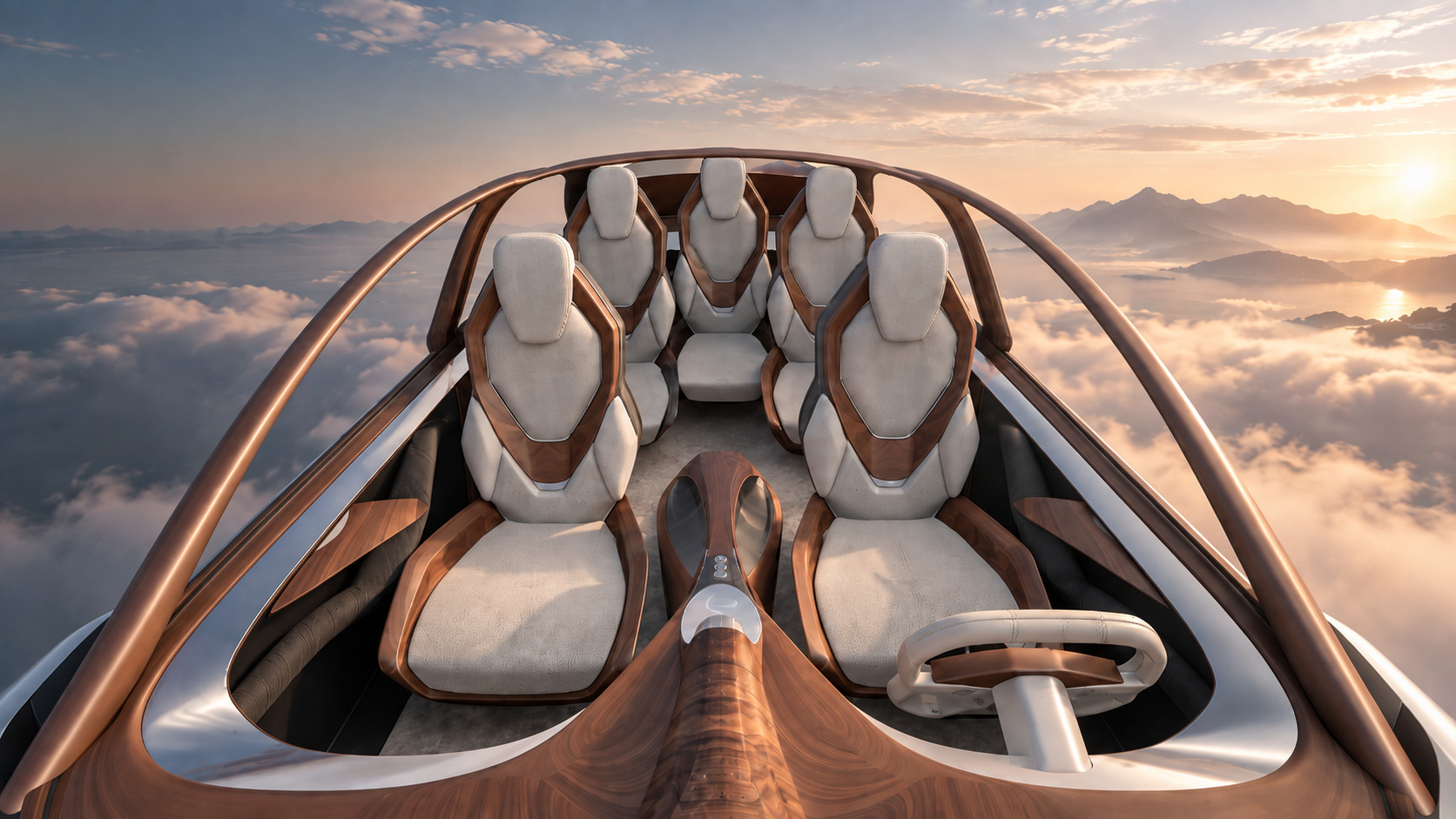
Onkochishin interior from above: five pale-grey seats framed in carved walnut, with a central console running between them.
Case study 02Client work

Onkochishin

The interior of an all-electric, five-seat DEUS hyperSUV.

Client
DEUS Automobiles
Programme
Onkochishin, interior of an all-electric five-seat hyperSUV
Status
Interior design concept
Scope
Interior architecture, seating, centre console, steering wheel, HMI, CMF, visualisation
Delivered
Package study, ideation and development sketches, 3D interior model, renders, three-trim CMF proposal
Sheet
Case 02 · Onkochishin × DEUS Automobiles

The brief

DEUS asked for a hyperSUV interior people would want to live with every day: a lifestyle space rather than a dashboard.

The problem

Five-seat performance cars usually sacrifice the middle rear seat, and electric interiors tend to default to one large screen. Both make a cabin feel generic.

Our answer

Fix the package first, then let classical craft and material carry the technology. Wood, metal and Alcantara set the tone; the digital layer lives inside them.

The principle

Learn the new by valuing the old.
Package

Shoulder room for all five.

Moving the middle rear seat back turns the usual compromise into the best seat in the car. Each of the five seats gets its own shoulder space, and the middle becomes the place to be.

Front

0rear shoulder zones overlapping

Set back, the middle seat clears the outer shoulders. Every passenger gets their own shoulder space.

Diagram, not to scale. Drag the middle seat, or use the arrow keys.

O.01Plan view. Two front seats, two rear seats and a fifth seat set back in the middle.
O.02Seat studies.
O.03Five-seat arrangements, explored in plan and perspective.
O.04Designed around the person: reach, posture and sightlines to the console.

Console, wheel

Drawn as objects, as if made by an artisan.

The centre console organises the whole cabin, so it was designed as a piece in its own right and carried from ink sketch to resolved surface. The steering wheel followed the same path.

O.05V-console, front view. Ink sketch.
Sketch to surface
O.06V-console in polished metal against tan leather.
O.07Blade console and control drum. Ink sketch.
Sketch to surface
O.08Resolved in brushed champagne metal.
O.09Steering wheel. Hexagonal hub, open squared rim.
Sketch to surface
O.10Steering wheel and wrap-around display.

The interior in use

Crafted first, then connected.

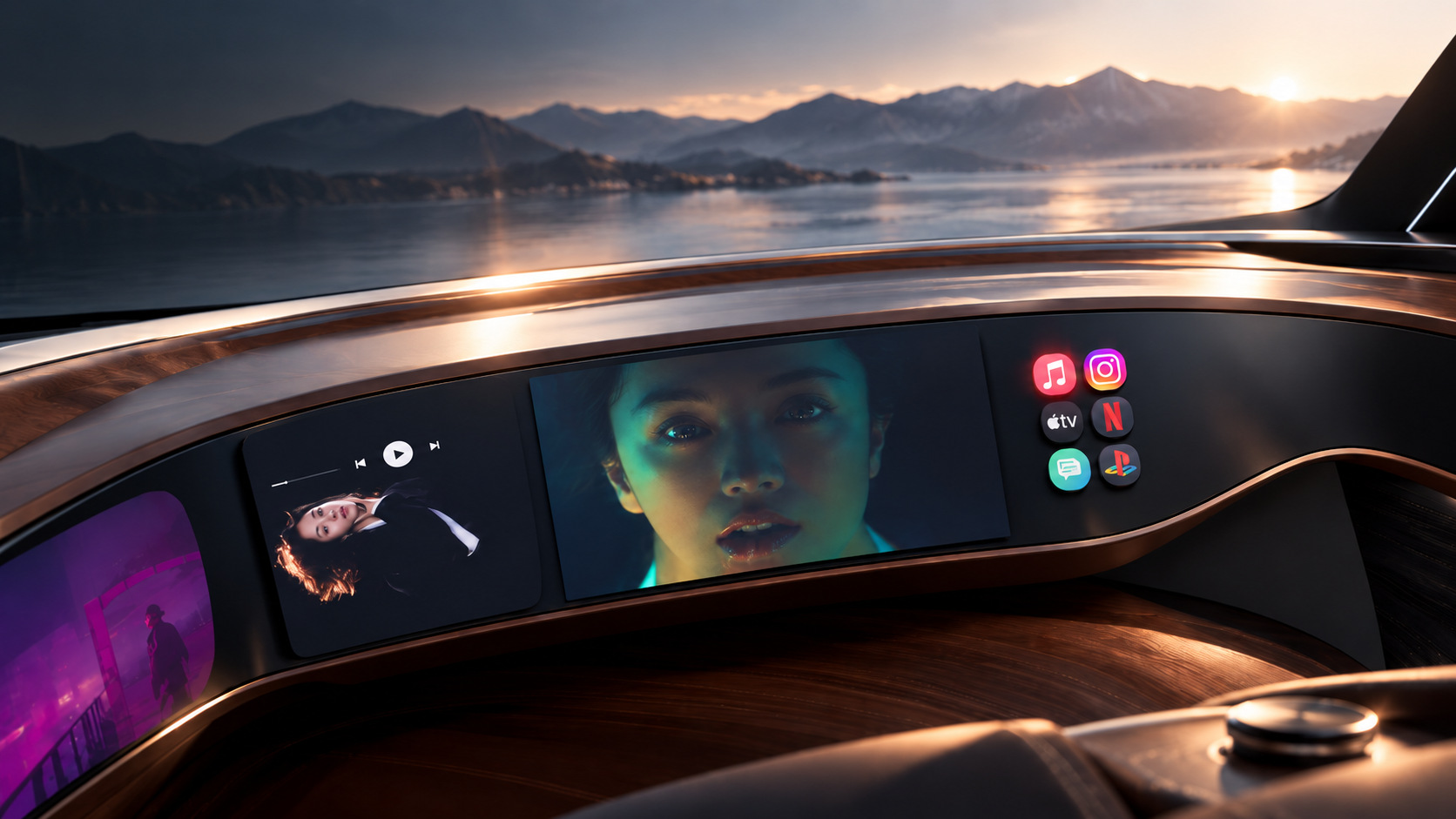
Wood, brushed recycled stainless steel and Alcantara set the tone. A wrap-around display, a hand-recognition start and immersive 3D audio sit inside that craft rather than on top of it.

The driver's view at dusk over snow: walnut dashboard, steering wheel and the console with its glowing hand-recognition panel. Animated illustration
O.11Touch the hand-recognition panel. The light rises through the console, then floods the screen on both sides: behind the wheel and across the passenger side.
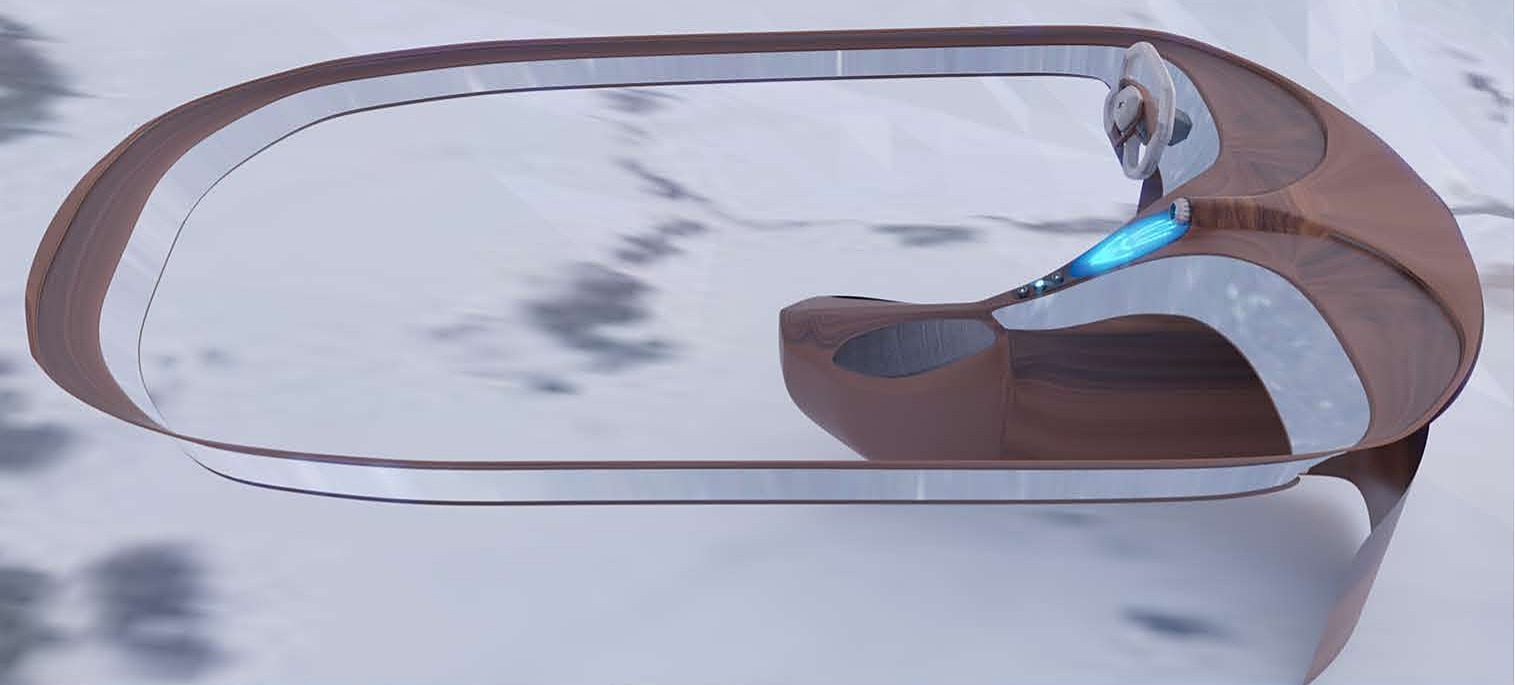
The dashboard and its screen as one continuous band around the cabin, seen from above.
O.12From above: the screen is one band around the whole cabin. The light leaves the console in both directions and meets at the far end.
The wrap-around display across the walnut dashboard, showing music, a film and apps, with a lake at sunset beyond.
O.13The display wakes screen by screen as the light passes. App icons are illustrative.
  1. 01Touch
  2. 02Up through the console
  3. 03Across both screens
  4. 04Around the cabin, display awake
O.14Hand-recognition start.
O.15The console from above, branching into the dashboard like a carved tree.
O.16Five seats, one shell.
O.17The console at night.
O.18A display that becomes the environment.
O.19From the rear seats, the display wraps the cabin.
O.20Immersive 3D audio, drawn as a sound field.

Outcome

What DEUS received.

  • 01A five-seat package with a distinctive rear layout that gives every passenger shoulder room.
  • 02A family of console, steering wheel and seat designs, each carried from sketch to rendered surface.
  • 03An HMI concept built around a wrap-around display, hand recognition and immersive 3D audio.
  • 04A three-trim CMF proposal in wood, recycled stainless steel and Alcantara.
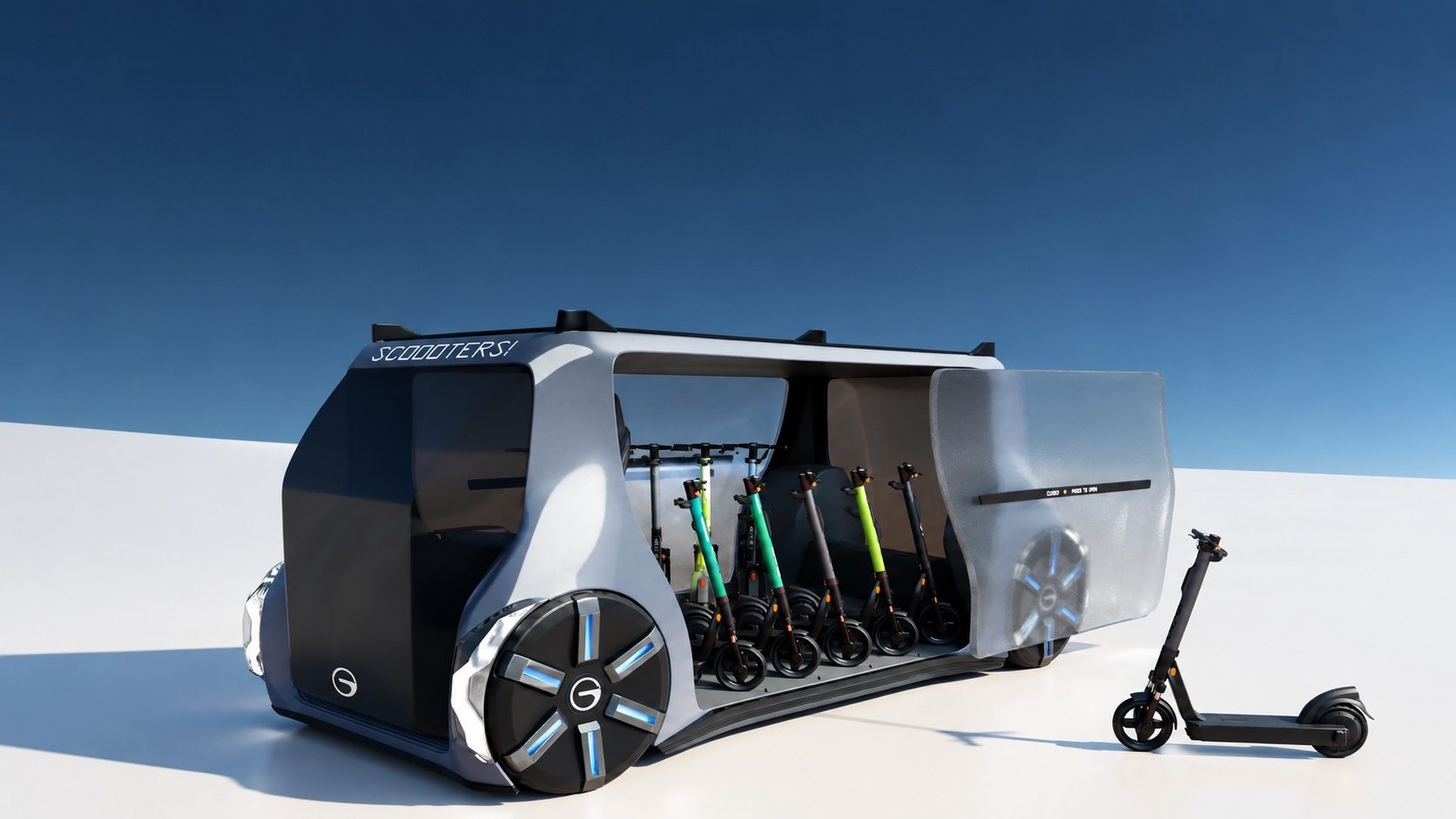
Geepy, a compact silver-and-black service vehicle with a wide side opening, carrying a row of colourful e-scooters on a white plain under a blue sky.
Case study 03Concept vehicle

Geepy

Your scooter is ready. A service vehicle that collects, recharges and redeploys shared e-scooters.

For
JAC
Programme
Geepy, micro-mobility service vehicle
Type
Concept vehicle
Scope
Concept, exterior, user experience, visualisation
Delivered
Service concept, exterior design, user journey, renders
Sheet
Case 03 · Geepy for JAC

The problem

Shared e-scooters end up wherever the last rider left them: on pavements, in doorways, in the way. Collecting, charging and redistributing them is a daily operating cost for every fleet.

The idea

A mobile unit that gathers scooters, recharges them on board, keeps them secure and brings them back to where people need them.

The approach

Design the service and the vehicle together. The user journey decides the opening, the racking and the lighting; the operator's route decides the architecture.

01 · Collect 02 · Recharge 03 · Deliver On-board charge Load 0 / 5
  1. 01 · Collect

    Scooters off the pavement.

    Geepy gathers shared e-scooters where they pile up and keeps them secure inside.

  2. 02 · Recharge

    Charged on the way.

    Racked scooters recharge on board, under a solar roof that covers the whole load.

  3. 03 · Deliver

    Ready where people are.

    The side opens and the scooter is waiting, on a sensor-guided, autonomous-ready architecture.

User experience, architecture

Easy to use, shareable, independent.

Functional and simple: a wide side opening for the rider, a glazed rack that shows what is available, and a roof that charges the load.

G.01The side opens and the scooter is ready.
G.02From above: solar roof, lidar camera at the front corner, scooters lit behind the glass.
  • Solar roof over the whole load
  • Lidar camera
  • Wide side opening
  • Autonomous-ready architecture
  • On-board charging racks

Outcome

What the concept shows.

  • 01A fleet-operations problem turned into a public-facing product with its own character.
  • 02A user journey designed alongside the vehicle: approach, open, take, ride.
  • 03An architecture ready for autonomous operation, shown at concept level.
  • 04A visual language that keeps a utility vehicle friendly in a pedestrian space.
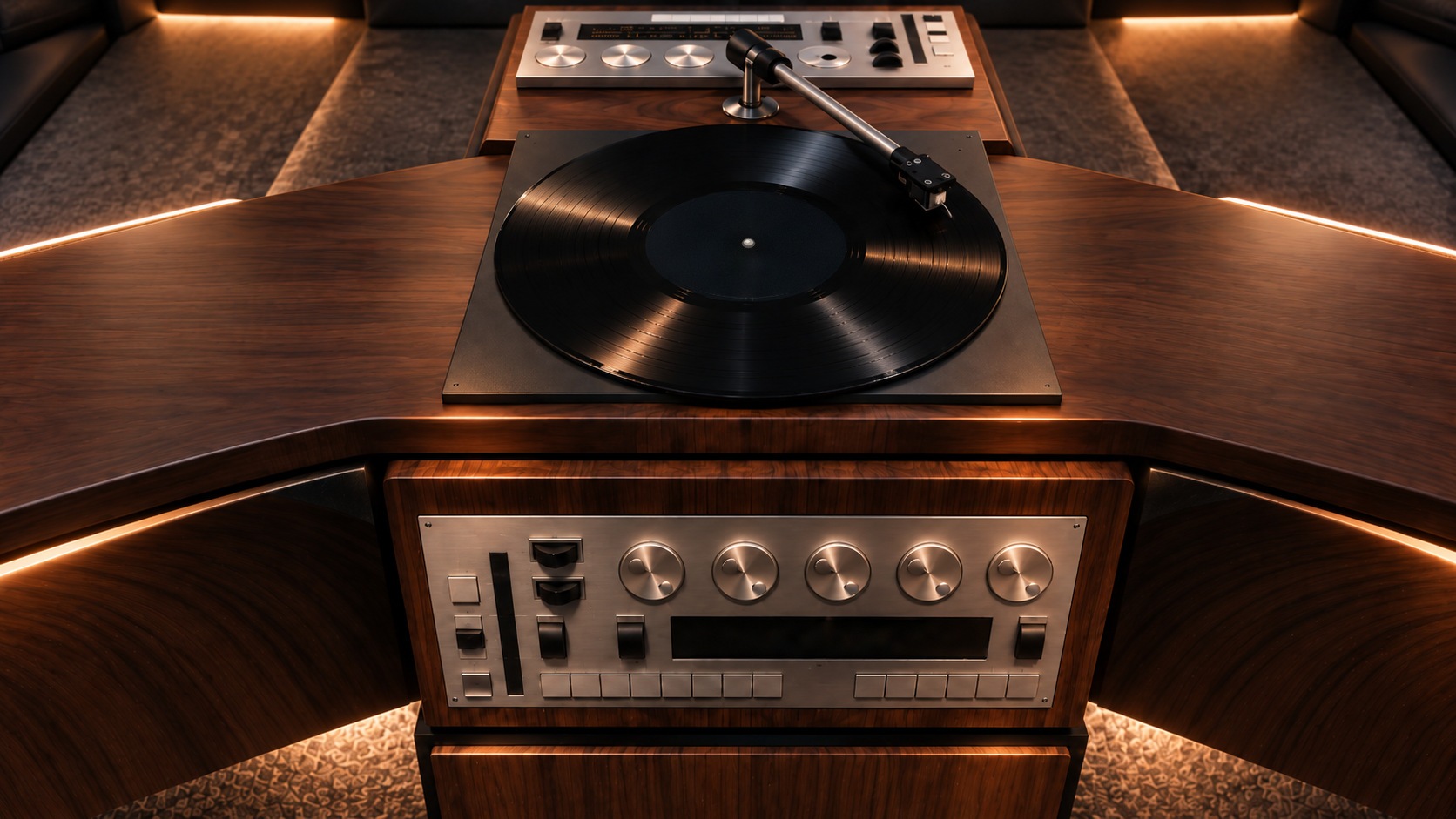
A record player set into a walnut table at the centre of the cabin, with a brushed-aluminium amplifier below.
Study 04Self-initiated study

Brionvega, imagined

If the radio became a room.

Type
Self-initiated brand study
Programme
An imagined Brionvega vehicle and interior
Status
Exploratory study, not affiliated with the brand
Scope
Packaging, exterior, interior, CMF, visualisation
Package
3.5 m long, 1.88 m wide, 1.7 m tall, two seating positions
Sheet
Study 04 · Brionvega, imagined

The question

Brionvega made radios, televisions and record players that people keep for life and display like furniture. What vehicle would that brand build?

The answer

A small room on wheels in walnut and leather, with a record player at its centre. Objects first, technology inside them, in the brand's own language.

Why it matters

This is how we test a brand's design language outside its usual category. The same method applies when a non-automotive brand asks what its vehicle, or its cabin, should be.

Length3,500mm
Width1,880mm
Height1,700mm
Seating2positions
B.01Package. Side sections and plans with two seating positions, stationed and forward.

Exterior

Wheels at the corners, perforated like a speaker grille.

A rounded capsule with a glass canopy and a dark central band, drawn to sit in a room as comfortably as on a street.

B.02Rendered sketch of the exterior.
B.03Side and plan, in development.

Interior

The cabin as one walnut shell.

Tufted leather lounge seating around a central table, with the record player set into it and record storage built into the walls.

The Brionvega cabin in the 3D model, seen from above: a walnut shell, black leather lounge seating on both sides, ambient light strips along the walls, and a Y-shaped walnut table with the record player at its centre.
3D model · top view 0.0 rpm
Click the record to play it. Drag it to turn it by hand.
Cabin lights
B.04The cabin in the 3D model, from above: a walnut shell, lounge seating on both sides and the record player at the centre of the Y-shaped table. The light colour and level are an illustration on the render.
B.05Marker sketch from above: walnut shell, tufted seating, central table.
B.06Vinyl player centrepiece, gap-panel detail, record storage.
B.07Lounge seating and record drawer.
B.08Storage built into the walnut panel.
B.09Early visualisation of the cabin at dusk.

A self-initiated study by Azeria Studios. Brionvega is a trademark of its owner. This vehicle is imagined and is not affiliated with or endorsed by the brand.

Working with Azeria

Four ways to start.

Each engagement has a defined scope, fixed deliverables and a clear next step. We quote per phase after a first conversation.

01Engagement

Technology integration study

For
Suppliers and technology companies whose component changes what a vehicle can be: propulsion, in-wheel motors, batteries, sensors, materials.
You receive
An architecture and package study, two or three vehicle directions built around the technology, key visuals and a narrative for OEM conversations.
Shown on this page
Onkochishin five-seat package · Geepy service architecture
02Engagement

Concept demonstrator

For
Companies that need to show a technology or an idea to an OEM, to investors or at a show.
You receive
Exterior and interior design, CMF, photoreal visualisation and short film, delivered as presentation-ready assets.
Shown on this page
Evangelum renders and studio film · Onkochishin interior
03Engagement

Vehicle design direction

For
New vehicle companies and advanced design programmes that need a car people recognise.
You receive
Positioning, sketch development, proportion and surface direction, a defined set of signature elements and a 3D design model.
Shown on this page
Evangelum for DEUS Automobiles
04Engagement

Vehicle and identity programme

For
Brands that need the product and the identity to speak one language, from emblem to bodywork.
You receive
Brand idea, emblem and wordmark system, vehicle design direction and launch imagery, developed in parallel.
Shown on this page
Evangelum and the DEUS rebrand · Brionvega study

Collaboration

Who we work with.

Anyone who needs transportation-design thinking — including outside the automotive industry.

  • 01OEMs
  • 02Mobility start-ups
  • 03Technology companies
  • 04Tier-1 suppliers
  • 05New vehicle companies
  • 06Investors developing mobility concepts
  • 07Engineering companies
  • 08Luxury brands
  • 09Marine and aerospace companies

The studio

Small by design.

Founded in Turin in 2025. No account layers: the people you meet are the people who draw. Vehicle, identity and technology are considered together, because customers experience them together.

CEO and Creative Director

Leary Estrada

Design strategy, brand identity, exterior design. Born in Los Angeles. BA Transportation Design, IAAD Torino. Finalist, Alcantara “Dress Your Vision”.

Design Director

Vladimir Pavlov

Form development, surfacing, design problem-solving. From Bulgaria. Transportation Design, IAAD Torino.

Press

  • Top Gear Italia · 26 August 2026
  • La Stampa · 1 September 2026
  • Torino Cronaca · 8 October 2026

Contact

We set directions.

Emaildesignazeria@gmail.com
Call / WhatsApp+39 333 535 3319
Webazeriastudios.com
Instagram@designazeria

Developing a vehicle, a technology or a brand that needs one? Tell us what it has to answer.